Father of American Choral Music
Born: Boston, Massachusetts, 7 October 1746
Died: Boston, Massachusetts. 26 September 1800

.png)
It has been suggested by some scholars that the frontispiece (shown above)
in the first Billings collection from 1770,The New-England Psalm-Singer,
by Boston patriot and engraver, Paul Revere,shows Willioam Billings seated on far left
leading a singing meeting
with a small group of men singers.
If true, that engraving is
the only known image showing William Billings.
The Musical Life of William Billings
Three questions might be asked about his music.
First question:
Why is this first major American composer not as well known
as other famous Bostonians, like Paul Revere and Sam Adams?The answer is he is not known as much
because though he was a singing teacher and composer,he also had many other jobs
in order to maintain his large family in Boston.
He was known primarily in Boston as a tanner.But he preferred to be known
as a singing master or tunesmith
for his music compositions and teaching singing schools.
Billings was in agreement with the protests
made by his singing friend Sam Adams,
who probably provided some or all the words to
one the greatest Billings choral compositions:
"Lamentation Over Boston" (1778)
His friend, Paul Revere,
designed the frontispiece illustration for the
first Billings music collection,The New-England Psalm-Singer, published in
1770 (see above illustration),That is the first major collection of vocal music
by an American composer.
Therefore, he should be much better known.
Second question:
Does he deserve to be better known?That question may be answered with one word -- Yes!
The main reason is that his music was the most respected
in his time and can still have meaning for us today.
Listen to one of his most moving musical depictions
drawn from a description of the death of Jesus Christ
and equating it with the sufferings during his own time,
as performed by two combined Lutheran church choirs,
with harpsichord accompaniment by Richard Hill,
all under the direction of Billings biographer, Roger Lee Hall:
CRUCIFIXION (Mourn, mourn ye saints)
Third question:
Are present day performances appropriate
re-creations of the music by William Billings?:And to answer the third question -- Yes and No.
Some performances strive to be as close as possible to the
Billings singing style -- an emphasis on the tenor (main melody) and bass
voices. But concerning tempo, the answer would be mostly -- No.
The performances are often much faster than Billings intended and often
too much emphasis on speed singing, especially with Sacred Harp singers.A bit of advice:
slow down and savor the beauty of these fine early American tunes!Billings was the best known and the most prolific composer
of choral music in 18th century America.
He composed over 300 pieces for chorus
published in six tune collections between 1770 and 1794.
The music includes: psalm tunes, hymns, anthems
and set pieces and no known instrumental works.
His best known tune is titled, CHESTER (first published in 1770;
with additional stanzas in 1778, and a new text not by him in 1786)
it was sung in the first episode of the acclaimed HBO televisionseries, JOHN ADAMS.
Here are two stanzas of the 1778 version:
Let tyrants shake their iron rod
And Slav'ry clank her galling chains,
We fear them not, we trust in God
New-England's God forever reigns.The foe comes on with haughty Stride;
Our troops advance with martial noise
Their Vet'rans flee before our Youth
And Gen'rals yield to beardless boys.
Michael Medved, is one of the few historians
to single out the importance of this Billings war song
in his time and in our time as well. This is what
he wrote in his book, The American Miracle (page 70):This brief song unforgettably captures
the unique combination of warlike determinationand unshakable faith that characterized
most of the American fighters and
inspired twentieth-century composer William Schuman to craft
his 1956 concert-piece, New England Triptych.The last section of the work, based on "Chester,"
brilliantly portrays the transition
from church-like reverence to inexorable march,
with "martial noise" and then to explosive
amazement, overwhelming gratitude,and sheet delight at victory.
In 1786, the Billings text was replaced,
probably because of such lines as:
"New England's God forever reigns."The alternate text in 1786 was not focused on wartime.
Listen to both versions of the tune:
"Chester" - William Billings - two versions
1778 (Billings words)
The largest collection with Billings tunes published
in the 19th century, was edited
by musicologist, Roger L. Hall,
in a music collection (or tunebook) from the 19th century:
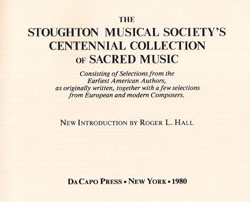
The Stoughton Musical Society's Centennial Collection
of Sacred Music (Boston, 1878/ Reprint, DaCapo Press, 1980)As the conclusion of his humorous anthem, MODERN MUSIC,
the words say:
"Tis the part of the hearers to clap their applause."So let's clap our applause loudly for
America's Father of American Choral Musicand The First Great American composer -
William Billings (1746-1800)
Here are a few compositions
from the first Billings tune collection:
The New-England Psalm-Singer (1770)
Anthem: ""As The Hart Panteth"(1770) -
William Appling Singers
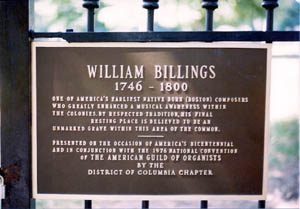
Memorial Plaque in Boston:
This plaque was placed on Tremont Street in Boston and reads:
One of America's earliest native born (Boston) composers who greatly enhanced a musical awareness within the colonies,
by respected tradition, his final resting place is believed to be
an unmarked grave within this area of the Common.
Presented on the occasion of America's Bicentennial and in conjunction with the 1976 National Convention of the
AMERICAN GUILD OF ORGANISTS
by the District of Columbia Chapter.

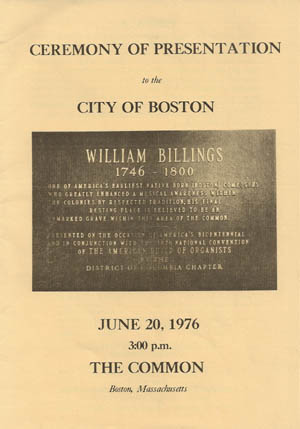
The presentation ceremony took place in 1976 at The Common and
included the singing of the best known piece by Billingsand the most popular war song composed by a native born citizen,
CHESTER. It is ironic that Billings was remembered
not by a Boston musician's organization
but by an organist chapter from Washington. D.C.
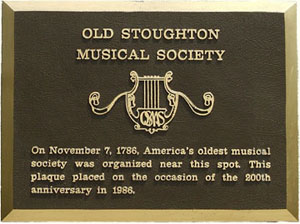
On November 7, 1986 (exactly 200 years after it was organized),
Roger Hall, Historian and Bicentennial Chairman of
the Old Stoughton Musical Society,
was a guest along with William Billings biographer, David McKay,
on the popular classical radio program,"Morning Pro Musica," on WGBH-FM
in Boston and hosted by Robert J. Lurtsema.There were several Billings
tunes played and a portion of this radio program
Billings Bicentennial in Boston:
It was on a rain soaked Tuesday -- a day of mourning
for an unfairly neglected American composer.
On that day and evening a "sing" was heldat King's Chapel (built in 1749)
at the corner of Tremont and School Streets in Boston.It was held on September 26,
the actual date when Billings died in 1800.
In observance of the 200th anniversary of his death,
an exuberant group of singers
from points far and wide, including England,sang selected hymns and anthems of William Billings.
The singing was organized by Billings 2000 coordinators:
Sheila Beardslee Bosworth, Gina Balestracci
and Roland Hutchinson (Garden State Sacred Harp Singers).
A large volume of music was prepared by Roland Hutchinson.In typical Sacred Harp fashion, various singers offered to lead the
individual Billings pieces.Neely Bruce came with his group of Sacred Harp singers
from Wesleyan University in Middletown, Connecticut.
Roger Hall, former conductor of the Old Stoughton
Musical Society Chorus,led two Billings tunes (STOUGHTON and MAJESTY),
plus an original canon titled, "Come Let Us Sing,"which Hall had composed
with words from the last Billings tunebook of 1794.
In celebration of the 250th anniversary of the
Declaration of Independence (1776-2026):
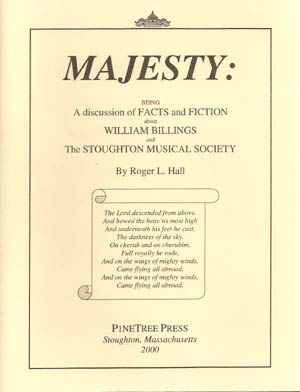
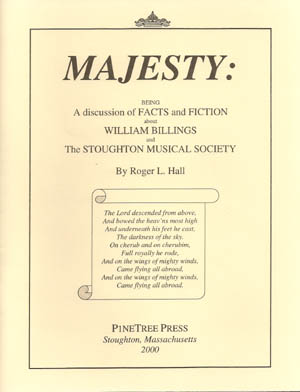
The expanded edition of this book is now available
Book and Audio Album:
The book includes the William Billings family genealogy
and facts and fiction about
Billings and The Stoughton Musical Society.It also includes concert
programs and other activities in Stoughtonincluding the 1774 singing school taught by William Billings.
Also these texts and tunes:
Anthem: THE PLEASURES OF VARIETY- text by Billings, 1794
music: Roger Hall, 1980
Canon: COME LET US SING - text by Billings,
music: Roger Hall,1986
Fuging Tune: MAJESTY - music: William Billings, 1778
Hymn Tune: STOUGHTON - music: William Billings, 1770,
edited by Roger Hall, 1986
This tune has an 18th century text by Isaac Watts and it was premiered by
the Old Stoughton Musical Society during its Bicentennial Concert
on November 7, 1986.
Audio Album:
Best of William Billings (AMRC CD)1. Canon: Thus Saith The High The Lofty One (1770)
2. MAJESTY (1778)+
3. CHESTER (1778 and 1786)
4. DAVID'S LAMENTATION (1778)
5. ANTHEM FOR THANKSGIVING (1794)
6. Interview with Roger Hall on WGBH-FM in Boston (1985)
7. MODERN MUSIC (1781)
8. STOUGHTON (1770)- edited by Roger Hall+
9. CLAREMONT (1794)
10. ANTHEM FROM SUNDRY SCRIPTURES+
11. ASSURANCE (1781)
12. EUROCLYDON (ANTHEM FOR MARINERS)(1781)
13. Interview on WGBH radio with Roger Hall and David P. McKay (1986)
14. CHARITY ANTHEM (1794)+
15. SHARON (1778) - edited by Roger Hall+
16. CRUCIFIXION (1786)+
17. THE PLEASURES OF VARIETY+ - music by Roger Hall, 1980, text by William Billings
18. DEDICATION+ - music by Roger Hall, 1986, text by William Billings
19. ANTHEM: O GOD MY HEART IS FIXED+
20. CHESTER (1786) - radio broadcast
+ = Premiere recordings = 10
See:The William Billings Singing School of 1774
The PDF book, MAJESTY and audio albumare available exclusively here
sent by Dropbox.
To order your copy of the book and audio album
for only $19.95, click the "Add to Cart" button.
After your have ordered your copy, for proper delivery
of the book, send your email address to
The Town of Stoughton, Massachusettsis celebrating its 300th anniversary in 2026,
where William Billings taught a singing school in 1774which later resulted is what is now
the oldest surviving choral society in America.
This choral society produced two tunebooks.
The second tunebook from 1878
has 28 tunes by William Billings
more than any other tunebook in the 19th century.
Here is the title page of the 1878 tunebook,reprinted in 1980 with a new preface by
musicologist, Roger L. Hall:
This page is made available from
Center for American Music Preservation
Copyright, 1998/Latest update, 2026
For Contact-- click here

.jpg)